
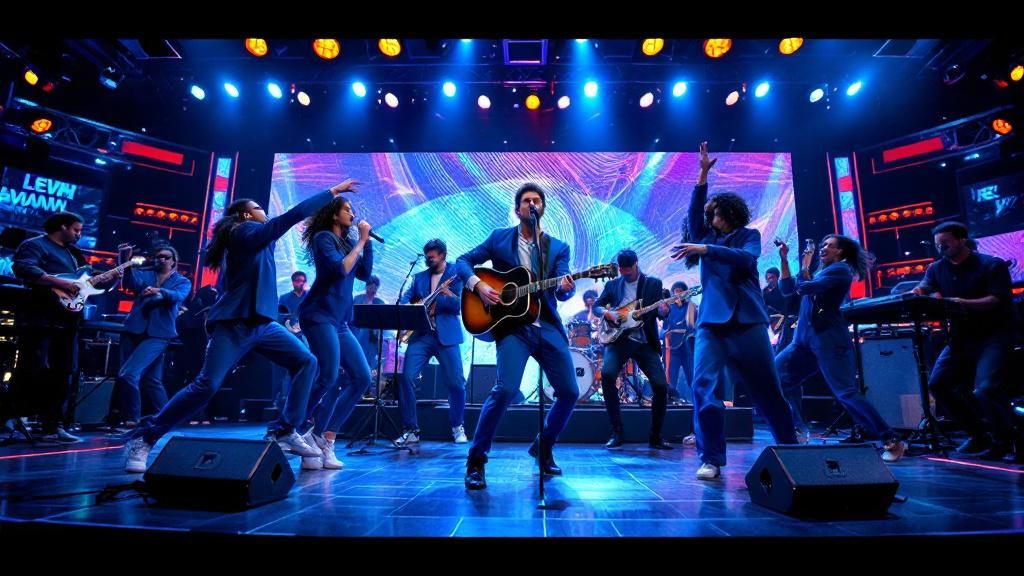
David Byrne contributed dynamic theatrical flair to The Late Show on 31 March, delivering a striking performance of “When We Are Singing” featuring Stephen Colbert. The Talking Heads principal artist, accompanied by a collective of blue-dressed performers, showcased the complete dance concept that has established itself as his hallmark. The track originates from his latest album, Who Is the Sky?, issued in September 2025. During his performance, Byrne discussed his conscious move towards vibrant, visually engaging shows and detailed his approach to integrating solo work with iconic Talking Heads songs on his current tour, including “Psycho Killer” and “Life During Wartime,” whilst upholding artistic integrity.
A Dramatic Return to Late Evening TV
Byrne’s performance on The Late Show marked a striking presentation of his developing creative outlook, one that emphasises visual grandeur and dance accuracy. The rendition of “When We Are Singing” exemplified his willingness to tackle composition with clever self-consciousness, drawing humour from the odd facial contortions singers inevitably adopt during live singing. When examining his songwriting approach with Colbert, Byrne revealed an near-scientific fascination about the mechanics of singing, noting how performers’ open mouths create an ambiguous expression that could indicate either ecstasy or simple physical necessity. This intellectual approach to performance art distinguishes his work from conventional pop entertainment.
The aesthetic transformation visible in Byrne’s ongoing tour showcases a intentional departure of his previous grey production design, a conscious choice rooted in current societal requirements. He outlined a coherent philosophy: the times demand colour and visual energy as opposed to austere minimalism. This transition reflects Byrne’s attunement to the emotional landscape of his listeners and his understanding that set design conveys significance as effectively as words or music. By partnering with his dressed ensemble, Byrne has created a cohesive visual language that supports his sonic investigation whilst conveying an optimistic, forward-looking artistic direction.
- Byrne intentionally chose “When We Are Singing” to highlight the ridiculous nature of facial expressions
- The ongoing tour showcases vibrant blue costumes replacing previous grey production aesthetic
- The show incorporates Talking Heads signature pieces paired with solo material from Who Is the Sky?
- ICE footage incorporated strategically at conclusion of “Life During Wartime” for effect
The Conceptual Framework Underpinning Who Is the Sky?
David Byrne’s most recent album, Who Is the Sky?, released in September, constitutes a extension of his enduring investigation into human behaviour, perception, and artistic expression. The record serves as a artistic fountain for his ongoing tour, with “When We Are Singing” exemplifying his ability to extract profound observations from everyday moments. Byrne’s method of songwriting stays markedly cerebral, converting ordinary observations into powerful musical stories. The album’s thematic concerns—how we portray ourselves, what our expressions reveal or conceal—shape every aspect of his stage shows, establishing a cohesive artistic statement that extends beyond traditional album promotion into territory that is more philosophically ambitious.
The artistic fusion between the new material and Byrne’s reinvented concert visual approach creates a cohesive experience for audiences. Rather than approaching Who Is the Sky? as simply another body of work to be performed, Byrne weaves its conceptual framework into the visual and choreographic dimensions of his productions. This holistic approach reflects his decades-long commitment to dissolving boundaries between sound, movement, and visual expression. By choosing particular pieces like “When We Are Singing” for elaborate theatrical treatment, Byrne illustrates how modern composition can transcend the recording studio and achieve full realisation as performance art on stage.
Transforming the Live Music Experience
Throughout his career, Byrne has consistently rejected the idea of static, unchanging stage shows. His approach emphasises continuous transformation and adaptation, treating each tour as an chance to reassess how music should be experienced live. The shift from subdued staging to bold, vivid visual presentation embodies this investment in artistic evolution. Rather than depending upon nostalgia or established reputation, Byrne intentionally creates fresh aesthetic vocabularies that enhance his current artistic preoccupations, ensuring that his shows remain contemporary and emotionally resonant rather than just revisiting the past.
Byrne’s partnership with his group of blue-clad performers represents a intentional commitment to dance narrative. By working with trained performers who grasp both movement and musical vocabularies, he crafts multifaceted shows where movement, costume, and sound communicate simultaneously. This multidisciplinary approach sets apart his shows from traditional concert formats, positioning them instead as immersive artistic events. The combination of classic Talking Heads material paired with original compositions shows that reimagining need not involve discarding one’s history—rather, it entails placing earlier work within fresh creative frameworks that respect their authenticity whilst investigating fresh directions.
Reconciling Tradition with Innovation
David Byrne’s method for handling his catalogue shows a nuanced understanding of artistic responsibility. Rather than dismissing his Talking Heads era or remaining solely identified with it, he has crafted a philosophy that enables him to honour the past whilst maintaining creative autonomy. This balance requires careful curation—selecting which classic tracks warrant inclusion in contemporary sets, and how they should be contextualised within new artistic frameworks. Byrne’s willingness to perform “Psycho Killer” and “Life During Wartime” alongside solo material illustrates that legacy doesn’t have to represent stagnation or cynical nostalgia-mongering.
The risk Byrne identifies—becoming a “legacy act that comes out and plays the old hits”—represents a genuine artistic trap that many veteran performers encounter. By strategically restricting his dependence on earlier material and regularly rethinking creative direction, he preserves creative credibility whilst honouring his past. This method protects both his creative principles and his listener connection, guaranteeing that concerts serve as vital artistic statements rather than retrospective showcases. His refusal to commit to a full Talking Heads reunion further underscores his dedication to artistic evolution over commercial convenience.
Talking Heads Work in Modern Context
When Byrne delivers “Life During Wartime” today, the song carries distinctly modern resonance. By securing ICE footage to complement the track’s ending, he converts a 1979 post-punk anthem into a reflection about current political circumstances. This curation—showing the imagery solely at the conclusion rather than across the entire performance—demonstrates sophisticated editorial judgment. The approach respects the footage’s emotional weight whilst avoiding the performance from turning excessively bleak or preachy, preserving the song’s creative authenticity whilst strengthening its contemporary significance.
This contextual approach transcends simple visual support. Byrne’s commitment to weaving Talking Heads material into his current touring ensemble’s artistic framework creates productive dialogue across temporal boundaries. The costumed performers and vibrant staging alter the way viewers encounter these familiar songs, stripping away retrospective preconceptions and demanding active engagement with their current relevance. Rather than preserving the songs in amber, this method permits them to evolve in fresh creative settings.
- Careful inclusion of established material forestalls artistic stagnation and legacy-act status
- Reimagined visual presentation strengthens contemporary relevance without undermining artistic authenticity
- Refusing reunion permits Byrne to determine how and when Talking Heads material appears
The Principles of Excellence
David Byrne’s approach to live performance extends far beyond simply playing songs—it constitutes a deliberately crafted creative vision grounded in visual storytelling and audience psychology. During his appearance on The Late Show, he expressed this outlook with characteristic thoughtfulness, outlining how ostensibly everyday observations about human behaviour inspire his creative choices. His rendition of “When We Are Singing” exemplifies this philosophy: the song emerged from Byrne’s observation that singers’ open jaws during vocal performance create an equivocal look—one that could indicate either profound ecstasy or mere physiological need. This dry observation transforms into stage material, illustrating how Byrne extracts material from daily life for creative substance.
This philosophical framework extends to his wider strategy to touring and stage design. Rather than viewing concerts as fixed renditions of pre-recorded work, Byrne sees each tour as an chance for total creative reinvention. His determination to introduce the current tour with colour—an intentional contrast to the grey aesthetic of his previous staging—demonstrates deeper convictions about art’s social responsibility. In his perspective, today’s audiences facing uncertain times require visual vitality and chromatic abundance. This is far from being a decorative choice; it embodies Byrne’s view that performance art has a responsibility to inspire and invigorate, to deliver sensory and emotional sustenance beyond just the music.
Why Colour Matters Now
Byrne’s explicit statement—”the times we live in, we need some color”—demonstrates how he frames creative choices within wider cultural landscapes. The transition from grey towards vibrant blue-costumed performers and colourful set design underscores his belief that visual aesthetics carry cultural and emotional significance. This decision acknowledges current concerns and doubts whilst offering an counterbalance through chromatic abundance. Rather than retreating into austere monochrome, Byrne insists that art should actively resist despair through its chromatic vocabulary, transforming the performance space into a venue of intentional, vital chromatic expression.
